
Deep roots in solid ground
exploring pride of place with my good pal Vergil

Before getting to the main event: a couple really wonderful people said some really nice things about my book. Brigid Pasulka is an excellent novelist and, I believe, loves the Midwest as much as I do. And I’ve been an admirer of Joe Pug for many years - I’m so grateful to have his endorsement for this collection of stories. Please read on for some thoughts about Vergil, place, and the goods of the regional writer.

In Book 2 of Vergil’s Georgics, the poet describes the oak tree, its roots extending down into Tartarus, its branches reaching into heaven:
Altior ac penitus terrae defigitur arbos,
aesculus in primis, quae quantum vertice ad auras
aetherias, tantum radice in Tartara tendit.
The oak is so deeply rooted, Vergil continues, that “no storms nor hurricanes uproot it,” while at the same time “it spreads afar / Its branches, and sustains a massive shade.”
The image of the oak returns in the Aeneid, this time representative of Aeneas. The tree, though blown by a strong wind in the mountain, stands firm because of its “roots that go as far / Toward hell as its top reaches up to heaven.” Aeneas, like an oak, remains firm in his resolve and his response to fatum despite Dido’s tears. In nearly identical words, Vergil expands his use of the oak from its agrarian setting to an image of Aeneas, and, by extension, Rome.
Though Aeneas is not again directly compared to an oak tree, throughout the epic the analogy deepens. After an uprooting from Troy and ensuing odyssey, Aeneas lands in Italy and begins to establish what will become Rome. His fate, his call, is to sink roots into a new land, to begin the establishment of the Roman people and the imperium Romanum. In this way, he completes the metaphor of the oak tree, sinking deep roots into Italy, establishing a Roman empire that will reach its branches throughout the entire world. In the estimation of the Roman people, the tree of Rome will reach even into heaven with the deification of its Caesars.
While Vergil uses the oak directly to describe Aeneas, we can read the tree by extension to apply to Vergil himself. Vergil’s work and influence have reached across time for two millenia, with centuries of Christians even considering him a pre-Christian prophet and believing him to have prefigured and prophesied Christ. Yet the poet is also deeply rooted in his native soil, in the Roman Empire and in his agricultural land of Mantua in northern Italy.
I wish to take the oak tree, and Vergil himself, as an example for the writer—specifically, for writers as diverse as Flannery O’Connor and Robert Frost, Garrison Keillor and Wendell Berry—writers who are rooted to their place, their land and people, but whose writing transcends that and reaches toward the heavens, toward readers outside their own land. In other words, writers who do what I wish earnestly to do in my own writing. Through the particulars of a place and time, a writer who fully exemplifies his country can reach a man generations and nations away, for, as Theodor Haecker wrote in his work on Vergil, “Man, be he of a thousand types and a thousand ages, remains eternally and unalterably Man.” The call of the regional writer is to embody his land and his people in his work. He must represent that land and people to his own people, for their own sake, but if he does so well, if he achieves true artistry, his work will reach toward heaven and beyond the bounds of his own soil.
Vergil’s first great work, The Eclogues, is a collection of ten bucolic poems that take as their model the work of the Greek poet Theocritus some two hundred and thirty years earlier. Vergil, though, does not simply imitate, but takes Theocritus as a launching point into his own work. Vergil’s shepherds are more earnest, more sincere than those of Theocritus. Vergil blends the pastoral setting and characters of Theocritus with the “deep feeling” of Greek classical poetry. In the Eclogues, we find shepherds in praise of love (“omnia vincit Amor”), in singing competitions, in small disputes, in praise of friends either absent or deceased. We also find the pietas that will become a defining virtue of Aeneas, Vergil’s Roman man: “With Jove the Muse begins: all things are full of Jove; / He cultivates the earth, my couplets are his care.”
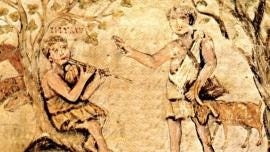
Pertinent to my current argument, in the Eclogues we see the first suggestions of Vergil’s rural life being important to and incorporated into his poetry. He is a man of the country, of his land and his farm. In fact, the first Eclogue begins in the shade of a tree (not an oak but a fagus, a beech tree), and within twenty-five lines, Rome is compared to a cypress-tree whose branches extend far beyond that of other cities, which are compared to viburna, wayfaring trees or guelder-roses. These wayfaring trees lack the depth of roots, the solidity of Rome, and wander without purpose or strength. Vergil expands this metaphor of the tree, rooted and reaching, in both the Georgics and Aeneid.
The oak itself appears in the first eclogue as a missed omen that tried to warn Tityrus of evil times: “I keep remembering how the oak-trees touched of heaven, / If we had been right-minded, foretold this evil time.” Meliboeus, meanwhile, the other speaker of the poem, laments the loss of his ancestral land, taken away to be given to “some godless veteran,” impius…miles. The land is central to this first eclogue, which sets the stage and tone for the other poems to follow.
Eclogue 9, for example, in part laments the eviction of Menalcas from his land. Here we see, too, another thread that is commonly woven throughout the Eclogues: the use of specific and occasional songs sung by the shepherds that Vergil sketches. These songs within the poem serve specific functions for the speakers and listeners; they are laments, competitions, eulogies, and cries of love. Vergil provides an example of particular art that both functions in a specific setting, but also transcends that to reach readers throughout centuries. The songs of Menalcas are as specific as to warn, “take care / While driving not to cross the he-goat—that one butts,” while reaching a reader far removed because of the plaintive reality of Menalcas being driven from his own land, threatened with death if he stays. The details of this butting he-goat serve to make even more real to us, across centuries, this shepherd’s life and loss.1
If the poet introduces his tender roots to the soil in the Eclogues, it is in the Georgics where they begin to deepen and strengthen their hold on the earth. Published in 29 BC, the Georgics—ostensibly agricultural instructions, in four parts, about the cultivation of field crops, trees, livestock, and bees—begin in earnest many of the themes that Vergil will bring to epic culmination in the Aeneid.
While the Eclogues had been set in a more or less mythical version of Arcadia, Vergil moves home for the Georgics, placing them in the agricultural land that he had known and worked for much of his life. He states boldly his artistic mission at the start of Book 3: “I will be first, if life is granted me, / To lead in triumph from Greek Helicon / To my native land the Muses….” Vergil cites myths and deities and writes that he will be “victor” and “priest” as he pursues “The woods and glades of the Dryads.” His artistic vision does not aim any lower for the humility of his subject in the Georgics. In this rural setting within the Roman Empire, Vergil begins his work of plumbing and extolling what he sees, or will come to fully realize in the Aeneid, as the great Roman virtues.
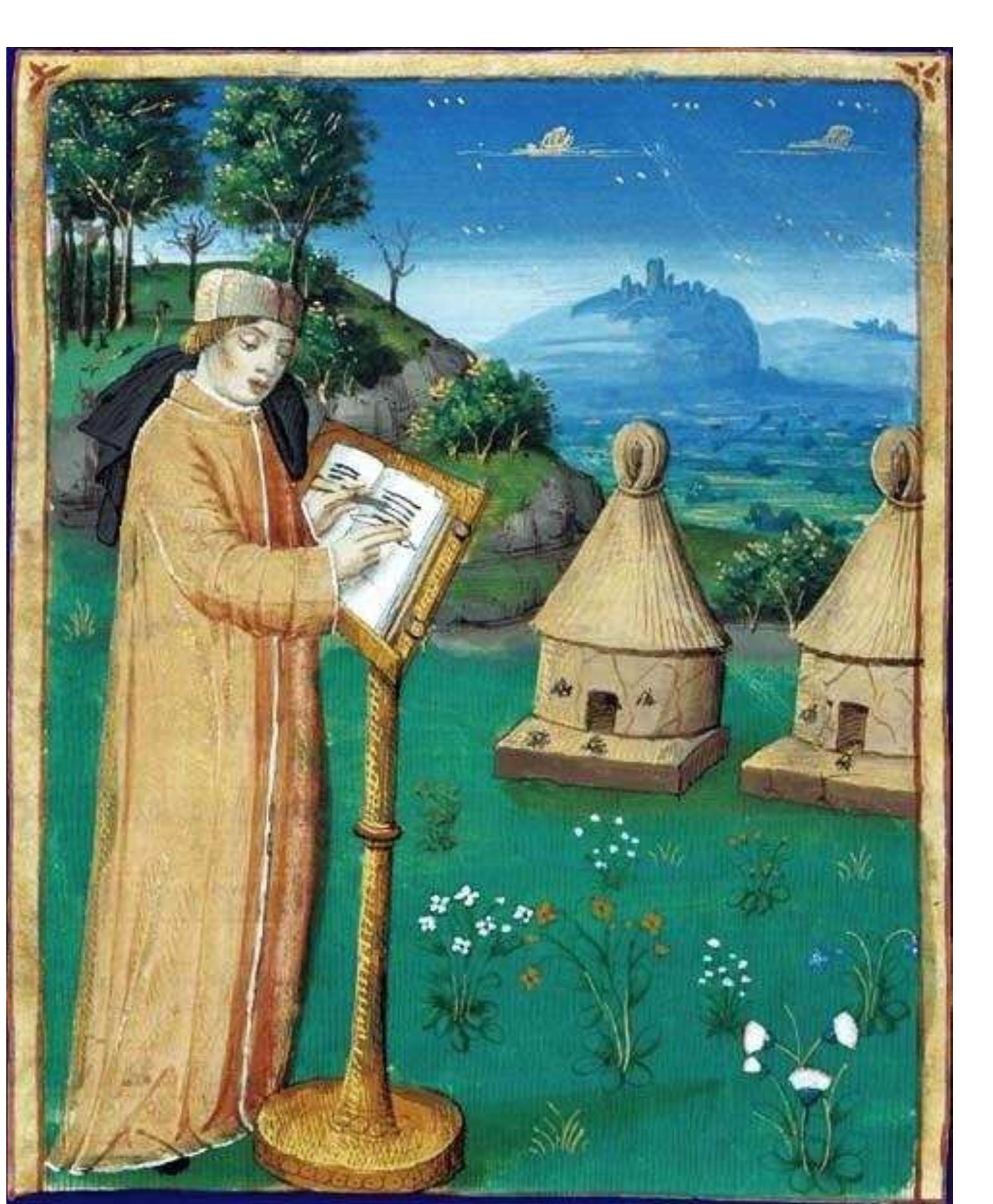
Thus, in Book 1 we read, “Above all, worship the gods, and to great Ceres / Pay yearly ritual of sacrifice,” and that “The Father himself / Willed that the path of tillage be not smooth.” These passages illustrate the virtues of pietas and labor that, as T.S. Eliot points out, will be key themes in the Aeneid. In the Georgics, Vergil emphasizes the necessity and power of labor: “Toil mastered everything, relentless toil.” This toil, the need for this labor to pull food from the earth, is ordained by the father Jove himself.2 There is something akin to the American capitalist, pull yourself up by your bootstraps-mentality in Vergil’s idea that toil and labor can master everything.
In Book 2, Vergil goes on to extol the life of the farmer, both the labor that he undertakes and the happiness of “he who knows the gods / Of the countryside.” The piety and labor that Vergil sees as characteristic of the Roman, later exemplified in Aeneas, are already present in the farmer of the Georgics. In the Roman fields are “a breed of youth inured to labour / And undemanding, worship of the gods / And reverence for the old.” As Vergil describes his own task within the poem, he aims “To invest such humble things with dignity.” The poet dwells on the “humble things” of his native place,3 through which he will win his “triumph” as a poet.
While the Georgics moved deeper into the land, rooted in Vergil’s soil and the labor of the farmer, the Aeneid takes what Vergil styles as the Roman virtues, brings them into the epic, and expands them to the imperium Romanum. With roots reaching deep into the earth, the branches of Vergil’s oak now spread out and, through the story of its founding, reach across the empire. In the Aeneid, the virtues of pietas and labor and the image of the oak tree are invested in the figure of Aeneas.
Expelled from his home—not unlike the farmer Menalcas—Aeneas is forced to journey, to follow the word of fatum toward a new place to establish for his people. Aeneas brings with him the pietas of devotion to his family and his household gods. Showing natural piety, he carries his father on his back out of the burning city of Troy, and, later, travels to the underworld to speak with his father again before establishing his new race in Latium. In supernatural piety, he brings with him his household gods and establishes the practice of penates in Rome.
Throughout the first half of the Aeneid, Aeneas is a wanderer who seeks home. Driven from his land, he is without rest until he can establish himself in a new, rightful home. It is important as well that this new home follows the dictum of fate and is in accord with Jove’s will. Though he settles into a new life in Carthage with Dido, the divine will reminds him that this place is not his home, is not his fated land. In pious submission to Jove’s decree, Aeneas leaves Carthage, leaves Dido, even at the cost of human scorn.
Aeneas brings his family and his household gods to Latium in order to establish a new line. These household gods, the gods of his own hearth and home, speak to him and “soldier after” him on his journey to a new home. Once Aeneas has reached Latium, he attempts to ally himself with King Latinus and the rites and gods and customs of the Latin people. “I’ll bring our rites and gods in,” Aeneas tells Latinus, but also, “With neither race the loser, / We’ll make a lasting bond, on equal terms.” Jove later adds to this,
…The Trojans will fade out
As they breed in. I’ll introduce rites,
But make one Latin people, with one language.
You’ll see the new race, with Italian blood,
Surpass the world—and gods—in piety.
In the Aeneid, the agriculture of the Georgics has deepened in richness and meaning to the culture of Rome. Roman culture and virtue are rooted in the land, in toil and pietas, and we see this development throughout Vergil’s works.
It’s also worthy of note that Aeneas fights this war, makes this pact, to found a line whose fruition and imperial dominance he will never see. His son Iulus will establish Alba Loga after thirty years, and another three hundred years will pass before Romulus founds Rome. Aeneas is committed to his land, his people, and his lineage throughout the centuries, not for his own benefit or glory alone.
In the progression of his work, Vergil is an exemplar of the regional writer, one who fully sinks his pen into the particulars of his place, the virtues (and at times ugliness, as in the passages about civil war and evictions) of the land and people. We see as his literary progeny Wendell Berry, for whom agriculture and community are so vital and integral to his work; Flannery O’Connor, who brings light to the failings in her community so as to bring it toward redemption; even Garrison Keillor, who seeks to find and shed light on the unique virtues of his place and his people. The list of writers touched by Vergil’s precedent could go on and on. The poet serves as a model for writers throughout generations of artists, and his work remains meaningful to this day for anyone who wishes to contemplate and live in the particulars of his own place. In my own writing, I hope to capture the particularities of the people and place of rural and Northern Minnesota—to write a true vision of what I see and know, both for my own Midwestern people, and to reach out, like the wide branches of the oak.
In his song “Treasury of Prayers,” Joe Pug sings a line reminiscent of the sacrifice of Aeneas and Iulus, praying that his children will “work to build cathedrals they won’t live to pray inside of.” Vergil’s poems are the cathedral that he has built, that we, centuries later, can still inhabit and draw from—and we, inheritors of this tradition, can add our own contributions to the cathedral of culture that we pass on from generation to generation.
For a people, a land, a community to survive and to matter, the members must be willing to serve a cause greater than the self. As a writer who desires to inhabit and encapsulate a specific place, I must be willing to serve that place in the particulars, to capture the truth of the specific place and people in a way that both does justice to those particulars and reaches to what is eternal in man. As Haecker writes, “The immense differences between man and man in time and space are infinitely less than the essential likeness.” Like Vergil, each of us in our own place can sink roots that tap deep into our patria’s native soil and grow branches that reach out to the transcendent and eternal in man. I pray that my own work can do justice to this call.
Odds and Ends
If you aren’t familiar with Joe Pug’s music, start with Nation of Heat and Sketch of a Promised Departure.
And if you aren’t familiar with Brigid Pasulka’s work, check out her novels as well!
I recently finished George Saunders’s latest book, Vigil. I’ve been a fan of Saunders for many years; about halfway through this one, I had some doubts, but he pulled it off at the end with greater complexity than I expected. A worthwhile read that has left me still mulling it over, with perhaps more to say at a future date.
I don’t know about you, but I love Spring Training. One of the best times of the year, filled with irrational hope that maybe this year things are going to turn around. Buxton will stay healthy, and Lewis, and Keaschall (that hope is already gone for Pablo), and Ryan will decide to stick around, and everybody will play there best, and this will be the year, my friends, this will be the Twins’s year, I just know it will be….
It is also true that art can and should at times serve a place and community specifically without needing to reach across time or place; for the present argument, I have space only to note that in passing, as it deserves a fuller argument of its own.
The parallel to the Genesis curse here is obvious—Julia Dyson Hejduk argues that Vergil was familiar with Genesis, and it is possible that the parallel is intentional.
Compare what Eliot argues, that in the Georgics “Vergil desired to affirm the dignity of agricultural labour, and the importance of good cultivation of the soil for the well-being of the state both materially and spiritually.”
Can't believe Joe provided a blurb. Well done! And agreed about Vigil. He left just enough room for mystery.